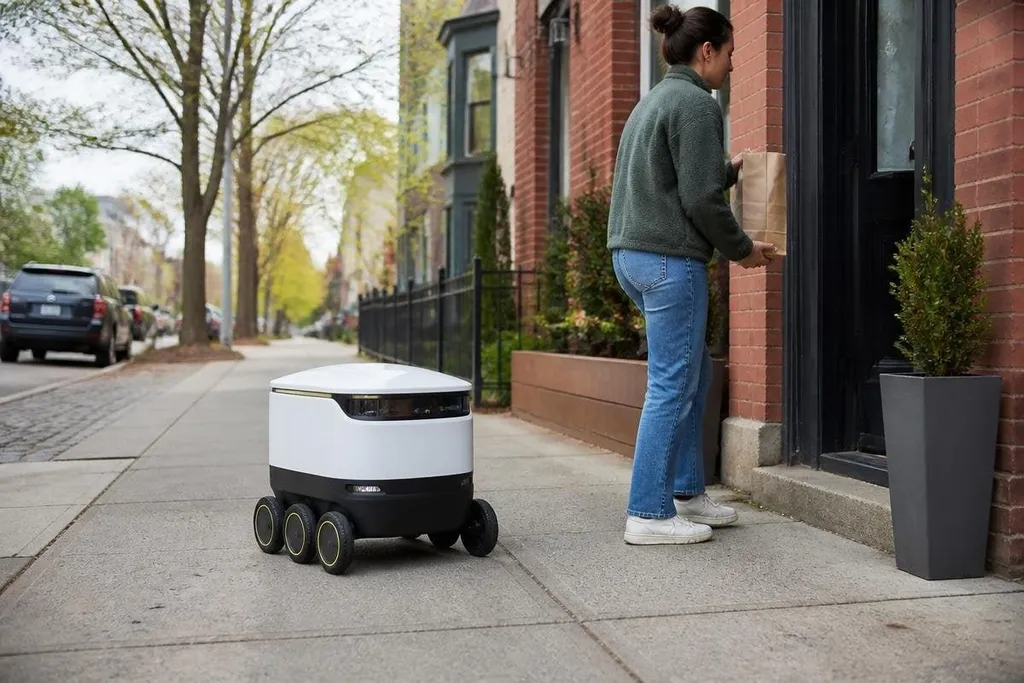
Sidewalk robots move small orders from nearby stores to homes without a driver in the vehicle. Their value comes from the short trip: a robot can leave a store, follow a mapped route, cross streets, and return for another order.
For a local delivery manager, the useful question is where that model fits, and where it still needs people.
- Short trips between stores and homes
- Remote help when a robot stops
- Lower vehicle use for small orders
What the robot does
A sidewalk robot usually combines cameras, LiDAR, wheel sensors, and GPS. LiDAR measures nearby objects with light pulses, while cameras help identify signs, people, curbs, and road crossings. The software joins those inputs to choose a path.
The robot moves at walking speed and carries a small insulated compartment. A customer opens that compartment with an app or another delivery code. That limits the order size, but it also makes the robot easier to stop and inspect than a full-size vehicle.
The route is usually planned before the trip, then adjusted as the robot meets real objects. A parked car, a blocked curb ramp, or a crowded footpath can force a pause.
The system may ask a remote operator for help when its sensors cannot identify a safe route. That remote link changes the job rather than removing it. One operator may watch several robots, but a difficult crossing or blocked path still needs a person to review the scene and choose the next move.
Where it fits local delivery
The model works best when the store and customer are close enough for a ground robot to make the trip on sidewalks. Groceries, prepared food, pharmacy items, and small retail orders fit the basic shape, provided the carrier can keep the load within its size and weight limit.
The store also needs a handoff process. Staff must place the order inside the compartment, confirm the address, and release the robot. A delay at that point can erase the time saved on the sidewalk, so the robot needs a marked parking spot and a clear loading routine.
Weather and street design matter too. Snow, heavy rain, steep ramps, broken pavement, and missing curb cuts can slow a route or stop it. A map may show a connected path while the actual sidewalk contains a barrier the robot cannot cross.
This is why local delivery teams should study routes one by one. A compact area with many short orders may suit robots; scattered homes, poor sidewalks, and frequent stairs may suit vans or bicycles better.
Safety and public space
A sidewalk robot shares space with people, wheelchairs, bicycles, pets, and maintenance crews. Its software must keep enough distance, stop when a person steps into its path, and avoid blocking narrow sections of pavement.
The physical design matters as much as the software. A low center of mass helps prevent falls, an audible signal can warn people nearby, and a remote stop function gives an operator a way to halt movement when the robot behaves badly.
Rules differ by city. Local authorities may set limits for speed, weight, operating hours, parking, remote supervision, and access for people with disabilities. A company that ignores those details can create delays for the city and extra work for its own team.
The open question is whether a robot can finish a delivery without adding work for the city or its remote operator. Robot24.com robotics coverage can trace that answer to the route, speed, payload, operator role, and trial date. The next section looks at what these systems still haven't shown.
What remains unproven
The main open issue is cost over a full route cycle. The robot still needs charging, cleaning, repairs, software updates, customer support, and remote supervision. Those tasks sit beside the hardware bill, so a cheap vehicle does not guarantee cheap delivery.
Service quality also depends on recovery. If a robot stops beside a blocked ramp, someone must reach it, guide it remotely, or move the order into another vehicle. That response can decide whether a customer sees the robot as useful or as an obstacle.
I’d back sidewalk robots for repeatable short routes, but I’d skip them for deliveries that need stairs, large loads, or tight time windows. The machine can handle a known path; the surrounding street still supplies the hard cases.
Before a pilot
Use this check before buying a fleet:
- Map the route on foot, including curb ramps, crossings, slopes, and narrow sections.
- Set the load limit from real order data, not the largest compartment size.
- Measure the store handoff from packed order to robot departure.
- Define who answers a remote help request and how fast they must respond.
- Test rain, low light, temporary barriers, and a full sidewalk during busy hours.
- Price charging, cleaning, repairs, supervision, and recovery work beside the robot.
A pilot should start with one route and a clear measure, such as successful trips per operating hour. If the robot needs frequent human rescue, the route needs changes before the fleet grows.
The next useful proof is simple: track completed trips, human interventions, and total cost for the same route across several weeks. That record will show whether the sidewalk robot is a delivery tool or an expensive way to move a small box.